
}Fast Approval
⛟Free Shipping
Exclusive Deals
ZOnline Prescription

Starting @ $35/month
- Thicker, Fuller Hair
- 24/7 Support
- FREE Delivery
4.1 ★★★★☆
9,078 reviews • Trustpilot

DHT Blockers starting @ $25/month
- Prescription Strenght Treatments
- Sprays, Serum’s & Oral Options
- FREE Shipping, Cancel Anytime
4.3 ★★★★⯨
777 reviews • Trustpilot

50% OFF Your 1st Month Membership
- Doctor guided dosage
- Unlimited Support
- 500,000+ Members
4.4 ★★★★⯨
16,732 reviews • Trustpilot

Oral Options starting @ $24.99
- All-in-One Options available
- Find Your Protocol – Today
- Science Backed Solutions
4.3 ★★★★⯨
32 reviews • Trustpilot

Starting @ $35/month
- Prescription Strenght Ingredients
- Unlimited Acces
- FREE Consult
4.3 ★★★★⯨
8,996 reviews • Trustpilot

Save up to 80% w/ Plush Care Prescription Card
- Online Prescriptions & Refills
- NO In-person visit needed
- Insurance Accepted, but Not Required
4.3 ★★★★⯨
2,745 reviews • Trustpilot

Get 15% OFF your Order
- Hair Re-growth & Confidence Boost
- Once-Daily does
- Easy, discrett Delivery
4.1 ★★★★☆
37 reviews • Trustpilot

Womens Biomarker Test @ $65
- Physician Consult
- Personalized Plan
- FREE Shipping
4.8 ★★★★★
12,142 reviews • Trustpilot

See Results in as little as 3 months
- 100% Online
- Sprays, Serum’s & Oral Options
- FREE Shipping
4.8 ★★★★⯨
19 reviews • Trustpilot

$150 per 3 month Minoxidal Supply
- FREE unlimited Doctor access
- 24/7 Support
- FREE Shipping
4.6 ★★★★⯨
7,940 reviews • Trustpilot
What Causes Hair Loss & How Do Treatments Work?
Hair loss is one of those things that feels deeply personal but is actually incredibly common – androgenetic alopecia (the medical term for pattern hair loss) affects roughly half of men and women by age 70, and for men specifically, it accounts for about 95% of all hair loss cases. Despite how common it is, the emotional impact is real: studies show the vast majority of men with pattern hair loss report real stress and self-consciousness about it, and the numbers are similar for women.
The frustrating part for a long time was how limited the actual treatment options were. For nearly three decades, there were only two FDA-approved medications for pattern hair loss at all – and while that’s finally starting to change with newer options in the pipeline, those two remain the proven, evidence-backed starting point for almost everyone:
- Minoxidil works as a vasodilator – it widens blood vessels in the scalp and helps push more hair follicles into their active growth phase, while also partially reversing the follicle miniaturization that causes hair to get progressively thinner over time.
- Finasteride works completely differently – it blocks the enzyme that converts testosterone into DHT (dihydrotestosterone), the hormone primarily responsible for shrinking hair follicles in men with pattern baldness. Reducing DHT at the scalp level slows the underlying process, not just the symptoms.
Because they work through different mechanisms, many providers recommend using both together for men – and the combination has shown meaningfully better results than either one alone.
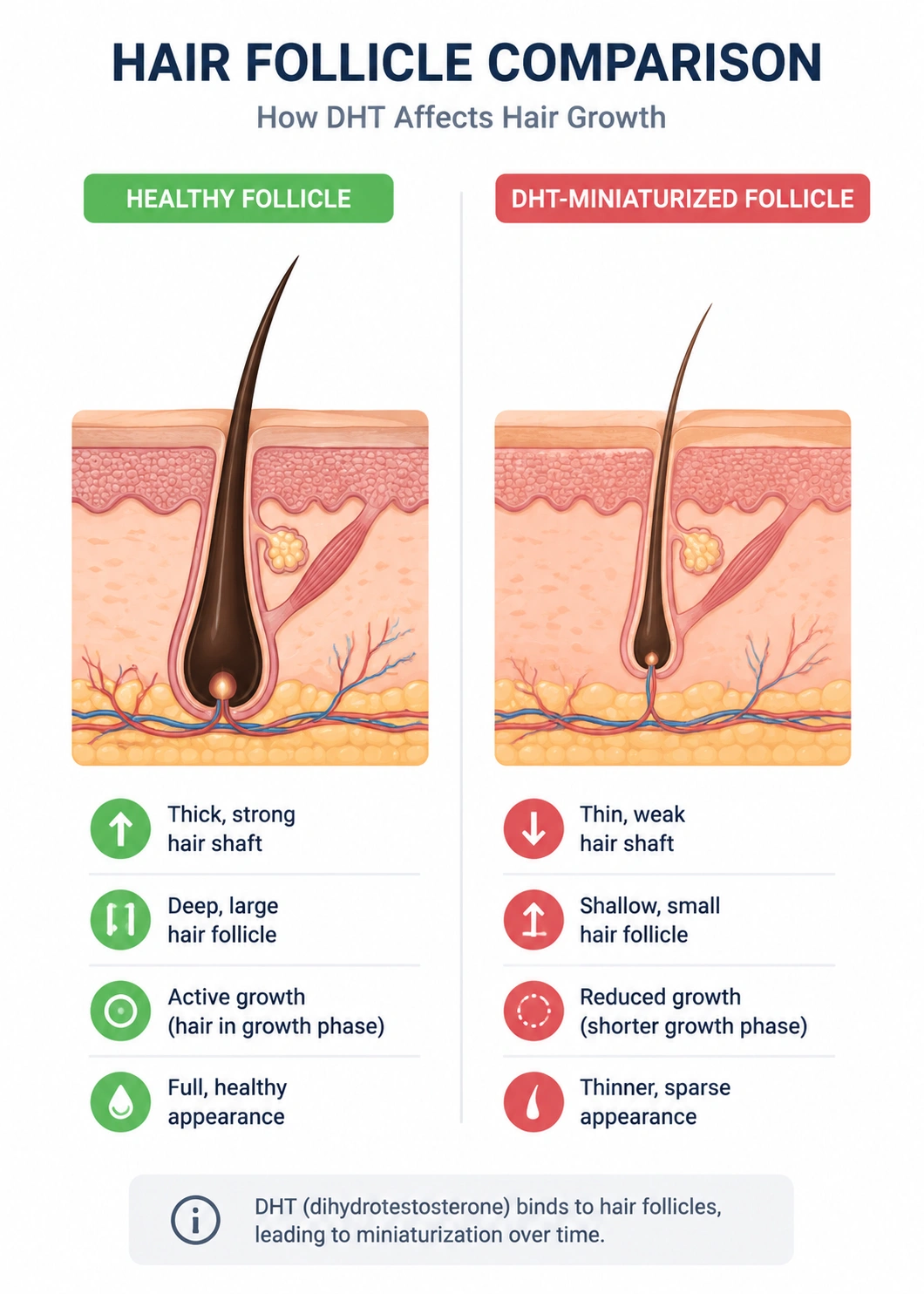
Minoxidil vs. Finasteride: What’s the Difference?
TOPICAL
Minoxidil
FDA Status — Approved for both men and women
How It Works – Widens blood vessels, extends the hair growth phase
Format – Topical solution or foam, applied to the scalp
ORAL
Finasteride
FDA Status – Approved for men only; not approved (and not recommended) for women of childbearing potential
How It Works – Blocks the hormone (DHT) responsible for shrinking hair follicles
Format – Daily oral tablet
Ideal when: Combined with minoxidil for men, since the two work through different mechanisms and tend to outperform either alone
Am I a Candidate for Hair Loss Treatment?
Most people noticing thinning, a receding hairline, or a widening part are dealing with androgenetic alopecia – but it’s worth confirming that’s actually what’s happening, since other causes (thyroid issues, nutritional deficiencies, certain medications, or stress-related shedding) can look similar and need a different approach entirely.
Generally, you may be a good candidate for treatment if:
- You’re noticing gradual thinning or a receding hairline consistent with a pattern (rather than sudden, patchy loss, which can signal something else)
- You want to slow further loss, not just address hair that’s already gone – minoxidil and finasteride work best at stopping progression and supporting regrowth in follicles that are still active, not restoring follicles that have been dormant for years
- You’re prepared for consistent, long-term use – both medications require continuous use to maintain results, and stopping typically reverses any gains within months
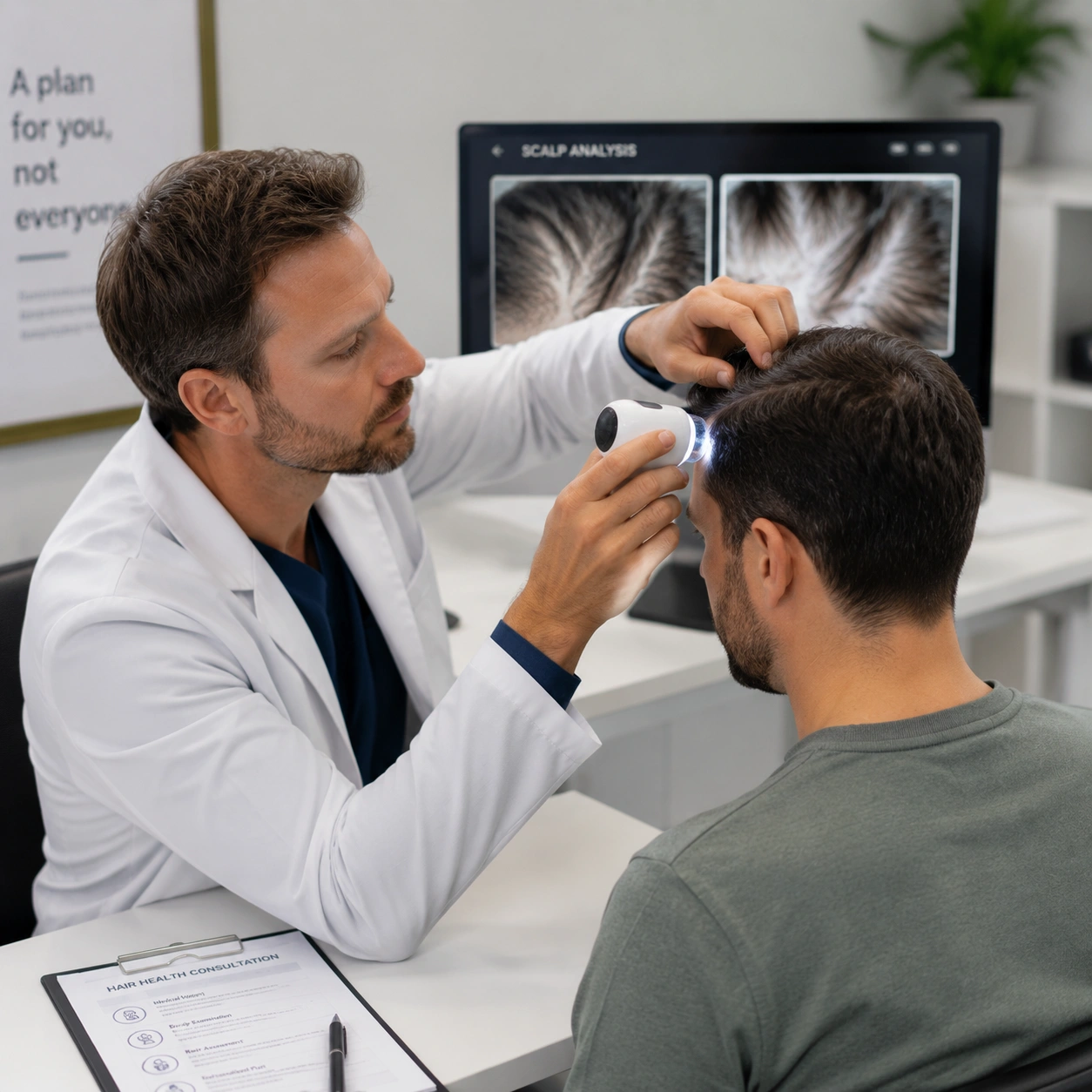
A provider can help rule out other causes and confirm you’re a good fit before starting treatment.
What Results Can You Expect?
Patience matters here – hair growth is slow by nature, and it typically takes months, not weeks, to see meaningful change.
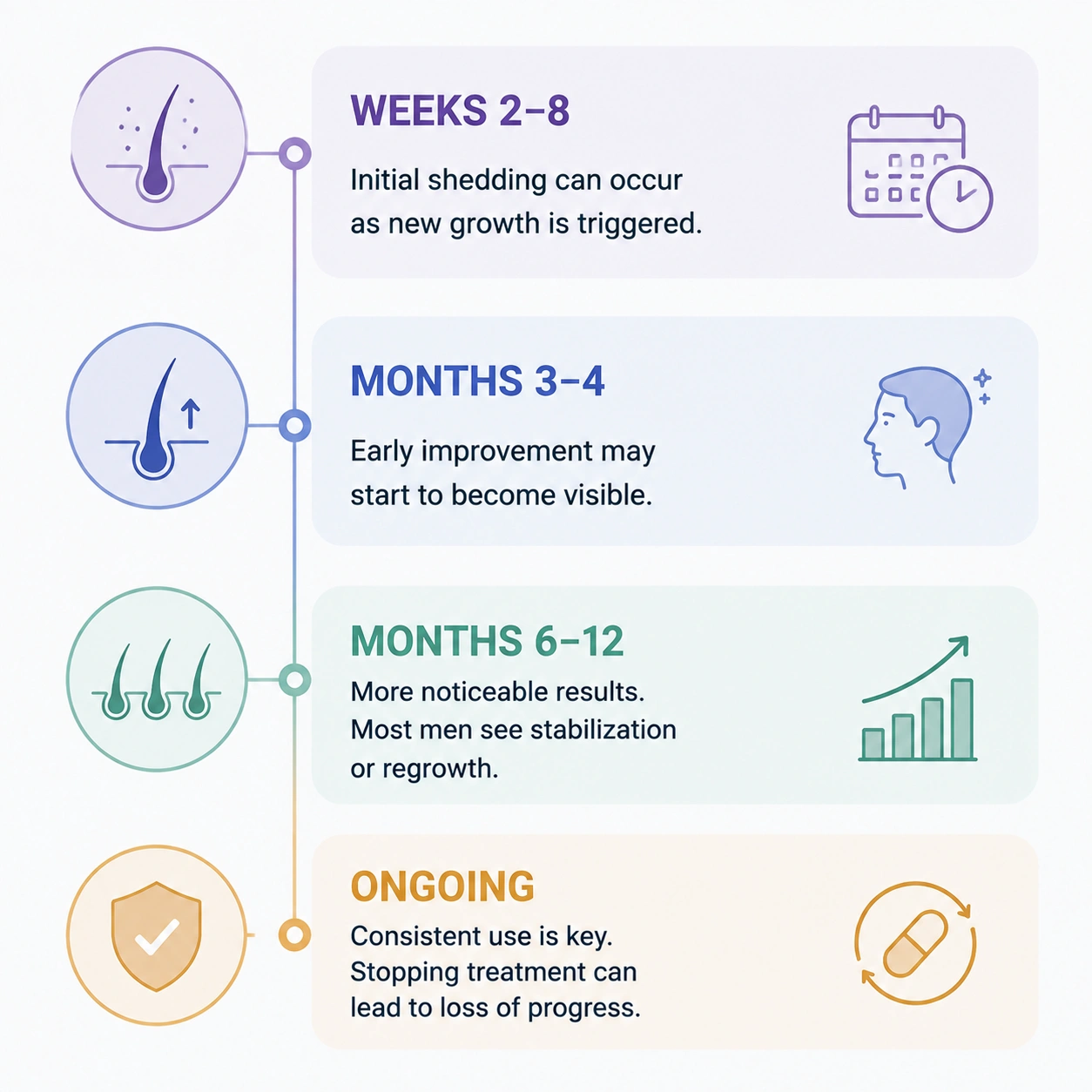
Typical timeline:
- Weeks 2-8: Some people notice increased shedding when first starting minoxidil – this is actually a normal sign the medication is pushing resting follicles into an active growth phase, not a bad reaction
- Months 3-4: This is typically the earliest point where visible improvement starts to show
- Months 6-12: Full results become apparent – clinical studies show finasteride slows or stops progression in roughly 83-90% of men, with regrowth in about two-thirds
- Ongoing: Both medications require continuous use – stopping treatment typically reverses gains within several months as the underlying hormonal/vascular process resumes
Combination therapy (minoxidil + finasteride, for men) tends to produce the strongest outcomes, with some studies showing hair loss stopped in up to 88% of men using both together.
Potential Side Effects
Both medications are considered well-studied and generally safe, but each comes with its own side effect profile worth knowing.
Minoxidil (topical):
- Scalp irritation or itching
- Unwanted facial/body hair growth (hypertrichosis) if the product spreads beyond the scalp
- Temporary increased shedding when first starting treatment
- 5% formulations are more likely to cause irritation than 2%
Finasteride (oral):
- Sexual side effects (reduced libido, erectile difficulty) in a subset of users
- Some ongoing scientific discussion about a possible link to mood changes in a minority of users – worth discussing directly with your provider if you have a personal history of depression or anxiety
- Not to be used by women who are or may become pregnant, due to risk of birth defects
Most side effects are mild and diminish with continued use, but they’re worth a real conversation with your provider – not just something to look up after the fact.
This is general information, not medical advice. A licensed provider can help you weigh these tradeoffs based on your own health history.
How to Choose a Provider
Marketing claims are easy to make, especially in a category as emotionally charged as hair loss. Here’s what actually signals a legitimate provider:
» Sticks to FDA-Approved, Evidence-Based Treatments
A trustworthy provider leads with minoxidil and finasteride – the two treatments with decades of clinical evidence – rather than pushing unproven “miracle” formulas.
» Licensed Medical Review
A real physician or provider should review your health history before prescribing finasteride specifically, given its contraindications.
» Realistic Expectations, Not Overpromising
Legitimate providers are upfront that results take months and require ongoing use – not instant transformations.
» Transparent Pricing
Clear monthly costs with no hidden fees or surprise charges after signup.
» Appropriate Screening by Gender
A provider should never prescribe finasteride to a woman of childbearing potential without a very clear, individualized medical conversation about the risks.
Red Flags:
Guaranteed regrowth claims, pushing proprietary “exclusive” formulas over proven treatments, no medical history review before prescribing, or unwillingness to explain the timeline honestly.
Frequently Asked Questions
Will minoxidil or finasteride work for everyone?
No treatment works for 100% of people, but the data is strong – finasteride slows or stops progression in roughly 83-90% of men, and minoxidil shows solid results for both men and women. That said, results vary based on how advanced the hair loss is when treatment starts – earlier intervention generally means better outcomes.
Can women use finasteride?
Finasteride is FDA-approved for men only and isn’t recommended for women of childbearing potential due to risk of birth defects in a male fetus if pregnant. Minoxidil remains the primary FDA-approved option specifically for women’s pattern hair loss.
What happens if I stop treatment?
Both medications require continuous use to maintain results. If you stop, the underlying process (DHT-driven follicle shrinkage for finasteride, or the vascular/growth-cycle effects of minoxidil) resumes, and any gains typically reverse within several months.
How long until I see results?
Most people don’t see meaningful change before 3-4 months, with fuller results typically apparent by 6-12 months. Hair growth is a slow biological process – there’s no legitimate treatment that produces overnight results.
Can I use HSA/FSA for hair loss treatment?
This varies by plan – hair loss treatment is sometimes considered cosmetic rather than medical, so it’s worth confirming eligibility with your specific HSA/FSA administrator before assuming it’s covered.
hairtreatmentscout.com is a free online resource that offers reviews and comparisons of companies and the products and services they provide. All representations and warranties regarding the accuracy of the information are disclaimed. Company trademarks featured on our site are the property of their respective trademark holders and listings on our site do not imply endorsement. hairtreatmentscout.com does not claim to represent every available company, product, or service existing in the market as a whole.
hairtreatmentscout.com may receive compensation from the companies featured on this site. All forms of rankings, evaluations, reviews, and opinions featured on this site are determined internally and subjectively. The hairtreatmentscout.com team works hard to keep site information up to date, but all information is presented “as is” and should not be assumed accurate.
All users of this site are subject to the site’s “Terms of Use.”